 Artifice
AI Dungeon Master in 3D: How Artifice Plays
Artifice puts an AI Dungeon Master on a real 3D tabletop. A rules engine rolls the dice, your mini moves on a 5 ft grid, and it all runs in your browser.
Most AI Dungeon Masters live in a chat window. You type, the model writes back, and somewhere in that conversation it is supposed to be keeping track of your hit points, the goblin’s armor class, and how far you moved. Sometimes it does. Often enough, it doesn’t.
Artifice is my attempt at the other version: an AI Dungeon Master on a real 3D tabletop. You tell the DM what your character does in plain words. A rules engine works out what actually happens, your miniature moves across a 5 ft grid, the dice land on the table, and the Dungeon Master narrates the result. It all runs in your browser: a browser TTRPG with 3D miniatures, and an AI DM with real rules underneath.
This page explains how the whole thing fits together, what works today, and what doesn’t yet. Each section links to a deeper post if you want the reasoning behind a design decision.
The short version
- The AI tells the story. Code runs the rules. Artifice uses a slightly modified D&D 5e (2014) ruleset, and dice, movement, attacks and hit points are resolved in deterministic code rather than by the language model.
- It’s a tabletop, not a transcript. Fights happen on a 3D board, with 3D miniatures and dice thrown on screen.
- Your character becomes a miniature. You describe your hero, Artifice paints a portrait, then turns it into the 3D mini that moves across the board.
- The grid is real. Every map uses true 5 ft squares, and the table warns you before a move provokes an opportunity attack.
- Maps are generated as you travel. There’s no fixed list of locations to run out of.
- The world keeps state. Promises, factions and consequences are stored as records, not left to a model’s memory.
- No install. If you can open a link, you can sit down at the table.
And the honest part: Artifice is in closed alpha. Today it’s solo only, the rules cover a focused slice of 5e, and multiplayer is coming soon. There’s more on limits further down.
Two jobs, two systems
There are two jobs at any tabletop. One is adjudication: does a 17 hit, how far can you move, how much damage does that take off. The other is narration: what the ambush looks like, what the bandit captain wants, whether the villager is lying.
The first job has exactly one correct answer. The second has no correct answer at all, and that’s the fun of playing. Language models are extraordinary at the second job and structurally unsuited to the first. So Artifice splits them.
The rules engine owns adjudication. Initiative order, attack resolution, cover, conditions, movement across the grid and hit points all run in ordinary code, the kind you can write tests for. In combat, every action, bonus action and reaction is tracked turn by turn.
The Dungeon Master owns the story. The model never sees a d20. It receives the outcome (the attack landed, the target is at 4 hit points) and turns that into a scene. The sentence about the blade glancing off a shoulder plate is generated. The 4 hit points are not.
This changes how a session feels. When the mechanics aren’t negotiable, you stop auditing the Dungeon Master and start talking to it. If you disagree with a mechanical outcome, you can trace it back to the dice and modifiers that produced it instead of arguing with a chatbot.
The trade-off is real, and I’d rather say it plainly: every rule Artifice supports has to be implemented explicitly. You can’t write a prompt that adds a subsystem. That makes coverage slower to grow, which is why the alpha covers a focused slice of 5e rather than every class, spell and feat in the book.
Deeper dive: The rules engine rolls the dice, not the model
The 3D tabletop
When combat starts, you’re looking at a 3D virtual tabletop, not a wall of text. The map is laid out in 3D, and your character and everything they fight stand on it as 3D miniatures. When you roll, the dice are thrown on screen, so you watch the result land instead of reading a number.
The interface keeps the numbers visible without making you do the maths. A typical turn reads like this: you’ve moved 30 ft, your action is ready, you roll 17 + 5 = 22 against AC 8, and it’s a hit. Then the Dungeon Master tells you what that hit looked like.
Your character, as a 3D miniature
Character creation ends with a figure on the table. You describe your character, Artifice paints a portrait from that description, and then turns the portrait into a 3D miniature. The figure you make is the one that moves across the board when you play.
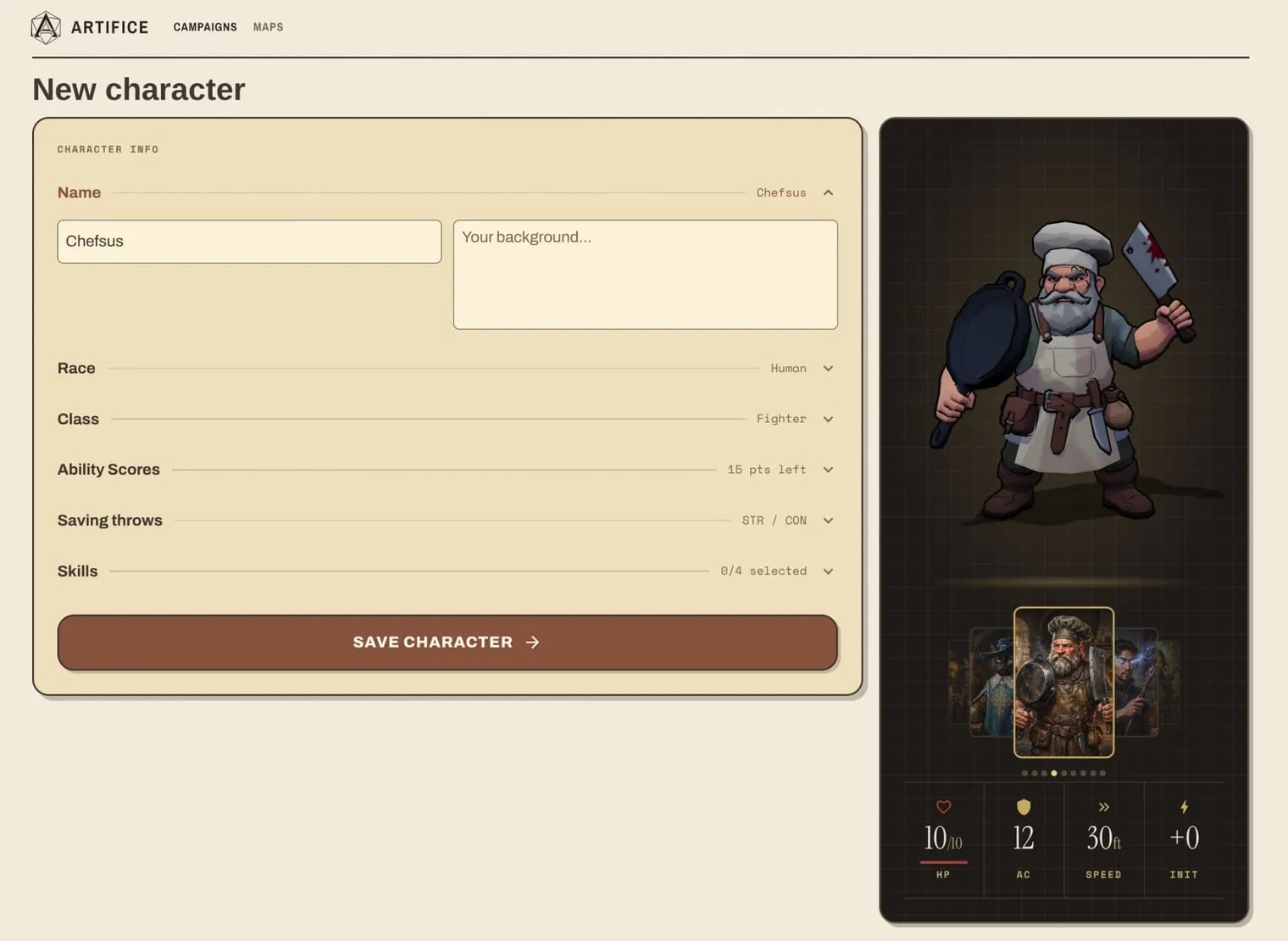
You choose your class and ancestry, and the description is yours. The homepage’s Krag the Beautiful, a goblin fighter, is one example. A human fighter with a cleaver and a frying pan is another.
A real 5 ft grid, and warnings before you provoke
The grid isn’t a texture laid over a picture. It’s the map’s actual coordinate system: every square is 5 ft, and distances, movement and reach line up with the numbers on your character sheet instead of being eyeballed.
That lets the engine answer tactical questions exactly: whether the captain is within reach, whether that dash across the road fits your movement or falls one square short, and whether stepping away from the bandit beside you provokes an opportunity attack. Every move is an ordered path of squares, and the engine checks each step before your miniature takes it.
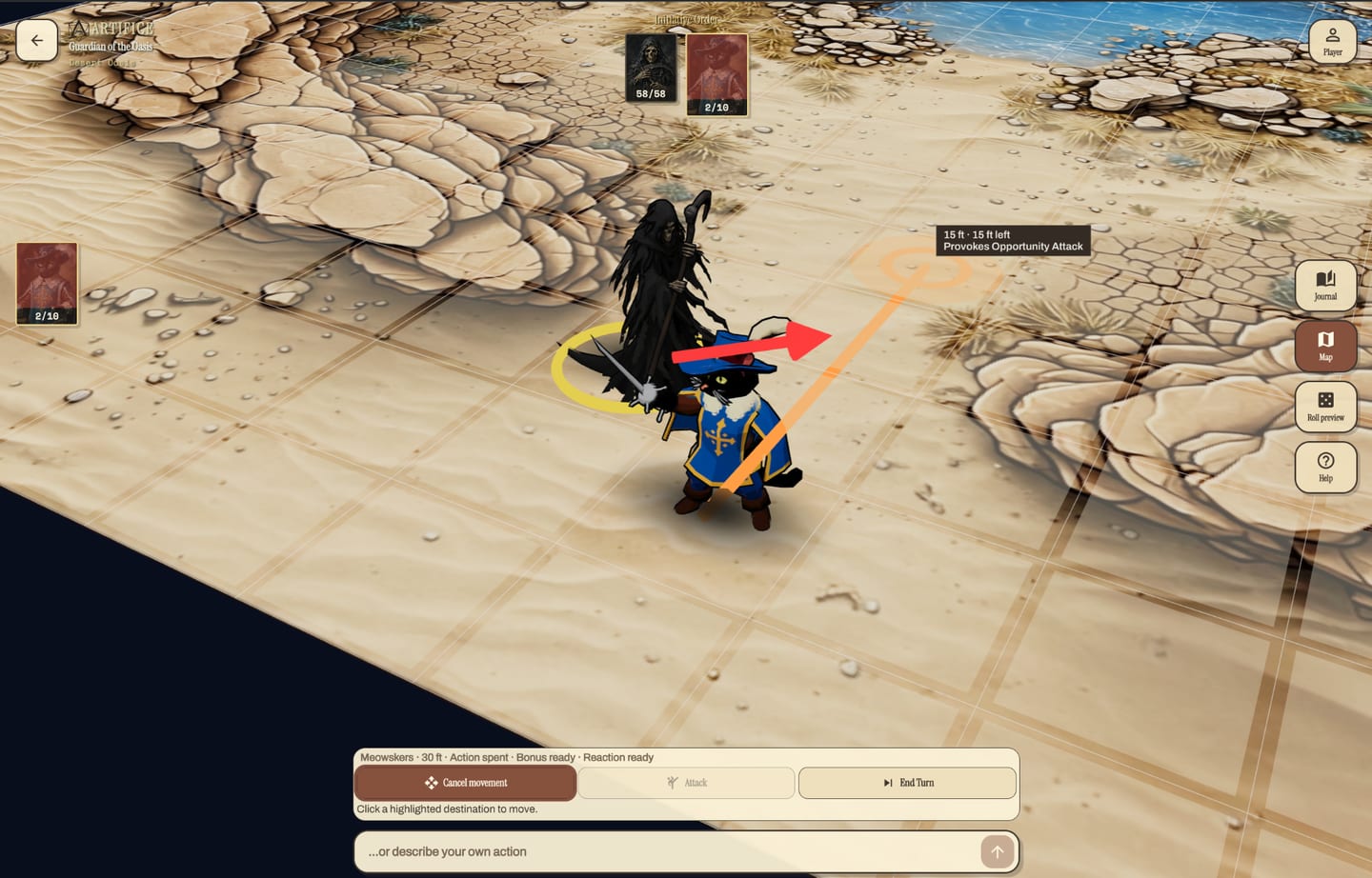
When you choose where to move, the table shows every square you can reach. Hover a destination and you see the route, its cost and how many feet you’ll have left. If the route leaves an enemy’s reach, the line turns orange, and the table points out exactly who gets a swing at you. That’s the moment in the screenshot at the top of this page.
Battle maps that are generated as you travel
Artifice generates its maps. When you set out for somewhere new, the Dungeon Master prepares the destination while you travel, and the scene opens on a map made for that place in that story.
So there’s no fixed list of locations waiting to be worked through, and no edge where the content runs out. Chase the thief into the marsh, follow the river to a village nobody has named yet, or turn around and go somewhere the Dungeon Master never planned for. Every map is drawn for your campaign, and every one plays on the same exact grid. In combat, NPCs can also be spawned dynamically to fit the encounter.
One limit: you can’t upload your own maps yet. I’d like to support that, and when it arrives it will use the same 5 ft grid.
Deeper dive: AI-generated battle maps on a true 5 ft grid
A world that remembers
The classic AI-DM failure arrives in session three. You talked the miller out of selling his land, wandered off for a session, and when you come back he greets you as a stranger. Once you learn that nothing sticks, the game stops being a world.
Feeding the whole history back to the model every turn doesn’t fix this. It gets expensive and slow, and it degrades quietly: it drops the one detail that mattered and keeps nine that didn’t. So Artifice treats the world as state, not as a transcript:
- A promise to the miller is a record attached to the miller: an obligation, made by you, still outstanding.
- If you burn down the warehouse, the warehouse is gone for that campaign.
- Factions carry their own goals and act on them between sessions, so the bandits you drove off went somewhere.
The Dungeon Master consults that state the way a human DM consults their notes. It can’t quietly retcon the miller, because his obligations aren’t something it remembers. They’re something it reads. Your campaigns and journal live on your account, and they wait exactly where you left them, mid-encounter if that’s where you stopped.
An honest note for the alpha: quests and non-combat NPCs aren’t in Alpha 1 yet, so you’ll see far less of the “living town” than this section describes. This is where the design is going, and the foundations are being tested now.
Deeper dive: What the town remembers
How this differs from a chat-window AI DM
There’s a whole category of AI Dungeon Masters that are, at heart, a chat conversation, ranging from general-purpose chatbots prompted to “be my DM” to dedicated apps. Many are genuinely good storytellers. Where that approach tends to struggle is everything that has one correct answer: arithmetic, positioning, and remembering what happened three sessions ago.
| Chat-window AI DM (typical) | Artifice | |
|---|---|---|
| Who resolves dice and combat | The language model, in text | A deterministic rules engine |
| Where the fight happens | Described in prose | A 3D table with miniatures and a 5 ft grid |
| Movement and reach | Approximated | Exact squares, with opportunity-attack warnings |
| Long-term memory | Whatever fits in the conversation | Stored world state the DM reads |
| Rules coverage | Broad, but approximate | Narrower today, but exact |
That last row is the honest trade. Artifice currently covers far less of 5e than a chatbot will claim to. My bet is that a game which handles a smaller set of situations exactly right is more playable than one that handles everything approximately. You can improvise around a rule that doesn’t exist yet. You can’t improvise around a rule that silently lies to you.
Browser-based, no install
There’s no client to download, no launcher, and nothing to keep updated. Artifice runs entirely in the browser. For the alpha, plan to play in a desktop browser. You’re welcome to experiment on mobile, but the mobile experience isn’t ready.
If you’re coming from a desktop-only 3D tabletop, this is a big part of the appeal. I wrote a guide to Sigil alternatives for people whose 3D VTT is shutting down, including the human-DM options that suit groups better today.
What works today, and what doesn’t yet
Artifice is early, and I’d rather you know exactly what you’re signing up for.
In the current alpha:
- Character creation with AI-generated portraits and 3D miniatures
- A selection of classes and ancestries, with leveling
- An AI Dungeon Master that narrates and responds to your actions
- Basic melee (martial) combat on a partial implementation of D&D 5e-inspired rules
- Dynamic NPC spawning during combat encounters
- Battle maps generated as your adventure unfolds
Not yet:
- Multiplayer (coming soon; Artifice is solo today)
- The full 5e ruleset, with every class, spell and feat
- Quests and non-combat NPCs
- Party member recruitment
- A full inventory and loot system
- A custom campaign creator
- Uploading your own maps
- Full mobile support
The Alpha 1 announcement has the full feature list for the playtest.
Join the Alpha 1 playtest
The Alpha 1 playtest runs from October 27, 2026 at 7 PM UTC to November 2, 2026 at 7 PM UTC. Sign-ups happen on Discord.
Join the Artifice Discord to sign up for Alpha 1
Play naturally, try something unexpected, and tell me where the Dungeon Master draws you in, where combat feels clear or confusing, and where something breaks.
FAQ
What is a 3D AI Dungeon Master?
It’s an AI that narrates a tabletop RPG while you play on a 3D table. In Artifice, the AI tells the story and a separate rules engine resolves dice, movement and combat, with your miniature on a 3D board.
Does the AI make up the rules or fudge the dice?
No. Artifice’s deterministic rules engine resolves dice, combat and character mechanics. The AI receives the outcome and narrates it. It doesn’t adjudicate the maths.
What rules does Artifice use?
A slightly modified D&D 5e (2014) ruleset. The alpha includes a selection of classes and ancestries, plus leveling, and more of the ruleset is added over time.
Do I need to download anything?
No. Artifice runs entirely in the browser. For the alpha, plan to play in a desktop browser; the mobile experience isn’t ready yet.
Can I play with friends?
Not yet. Artifice is solo today. Multiplayer is coming soon.
Can I bring my own maps or miniatures?
Not yet. Maps are generated by Artifice as you travel, and your miniature is generated from the character you create.
How do I get access?
Artifice is in closed alpha. Sign up for the Alpha 1 playtest (October 27 – November 2, 2026) through the Artifice Discord. For more answers, see the FAQ.
Artifice is an independent game and is not affiliated with Wizards of the Coast. Dungeons & Dragons is a trademark of Wizards of the Coast.